

Microplastics are increasingly making headlines. These extremely small plastic particles, often invisible to the naked eye, are now found in the environment, in our food, and even in the human body.
In recent years, scientific research has been taking a closer look at their ubiquity and their potential health effects. Without causing undue alarm, one thing is clear: we don’t yet have all the answers, but we can already take concrete steps to reduce our exposure, particularly through the water we drink every day.
In Quebec, whether you live in Quebec City, on the North Shore, the South Shore, in the Eastern Townships, in Granby, or in the Greater Montreal area, drinking water is strictly regulated. However, certain emerging contaminants, such as microplastics, are raising new questions.
What exactly are microplastics?
Microplastics are plastic fragments measuring less than five millimeters. They result either from the breakdown of larger objects, such as packaging, bottles, or synthetic textiles, or from particles intentionally manufactured at a very small size for industrial uses.
There is also talk of nanoplastics, which are even smaller and capable of crossing certain biological barriers. The finer the particles, the harder they are to detect and filter out.
Today, these particles are present in the air, soil, rivers, and lakes, as well as in many foods and beverages. Their presence is widespread, constant, and cumulative.
Why is there so much interest in this topic in research today?
Microplastics are not a recent phenomenon. What is new are the tools that allow us to measure them more accurately and track their path through the body.
Recent studies have shown that they are present in several human organs, including the liver, kidneys, placenta, and, more recently, the brain. Some research also suggests possible links to neurological or cardiovascular disorders, although the exact mechanisms remain to be clarified.
It is important to note that the scientific community remains cautious. Researchers speak more of clues and correlations than of absolute certainties. That said, given that global plastic production continues to rise, the issue of long-term exposure cannot be ignored.
What about tap water?
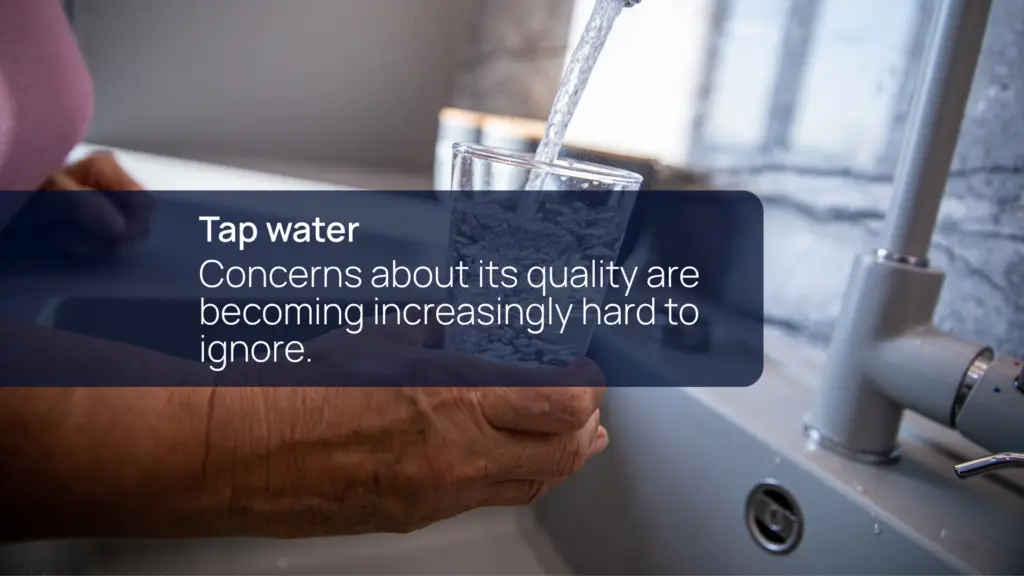
Several studies conducted around the world have detected microplastics in tap water. Quebec is no exception to this reality.
This does not mean that the water is undrinkable. Municipal water systems adhere to strict standards for bacteria, heavy metals, and regulated contaminants. However, microplastics are not yet among the parameters that are systematically tested.
The presence of microplastics may vary depending on the water source, treatment methods, and infrastructure. Well water may also contain microplastics, particularly due to the soil, reservoirs, or equipment used.
Can microplastics be detected through water testing?
In most cases, no.
Standard water tests are designed to measure well-known and regulated substances. Microplastics require much more complex and costly analytical methods that are still largely unstandardized and are used primarily in scientific research.
In other words, the absence of results does not mean there are no microplastics. That is why the current approach focuses more on prevention and reducing exposure than on individual detection.
The main sources of exposure at home
Although it is impossible to completely eliminate microplastics from our daily lives, certain factors contribute to higher levels of exposure, including:
- drinking unfiltered water
- the use of heated plastic containers
- highly processed foods
- single-use water bottles
Drinking water is an important lever, since it is consumed every day and used for cooking and preparing many beverages.
Reducing microplastics in water therefore helps limit a constant source of exposure.
What solutions are available to reduce exposure through water?
No technology can guarantee the complete elimination of all microplastics. However, certain solutions can significantly reduce their presence and are certified and validated.
Reverse osmosis using a “Total Defense” cartridge, installed at the point of use, remains the most effective technology available today for reducing a wide range of contaminants, including microscopic particles. Thanks to an extremely thin membrane, this type of system provides much more thorough filtration than traditional solutions.
Activated carbon filtration can help reduce certain particles and improve the taste and odor of water, but it has its limits when it comes to the finest particles.
However, it is essential to remain transparent. We are talking about reduction, not an absolute guarantee. Research is evolving, and so is our understanding.
Why a personalized approach makes all the difference
Every home has its own unique circumstances, whether it’s the type of water, the infrastructure, or consumption habits. A solution that works well for one household may not necessarily be suitable for another.
That is why support and advice are essential. The goal is not to offer a single product, but to recommend a solution that is tailored to the household’s actual situation.
With this in mind, Culligan Québec supports families throughout Quebec—on the North Shore, the South Shore, in the Estrie region, in Granby, and in the Greater Montreal area.
In summary
Microplastics are now ubiquitous in our environment. Science is advancing rapidly, but many questions remain unanswered. Drinking water, however, represents a concrete area where action can be taken right now.
Certain technologies, such as reverse osmosis, can reduce exposure when properly adapted to each situation. An honest, preventive, and personalized approach remains the most responsible one.
If you have questions about the quality of your water or about possible filtration solutions for your home, a Culligan expert can guide you and help you make an informed decision.
Sources and References
- Washington Post
Article on new data regarding microplastics and their potential effects on human health (January 2026).
https://www.washingtonpost.com/climate-environment/2025/12/30/microplastics-human-body-brain/ - University of New Mexico
Research on the presence of microplastics in human tissue, including analyses of brain tissue.
https://hsc.unm.edu/news/2024/08/microplastics-human-brain.html - University of Rhode Island
Experimental studies on the neurological effects of microplastics, particularly as they relate to cognitive impairments.
https://www.uri.edu/news/2025/01/microplastics-alzheimers-study/ - University of California, Riverside
Research on the possible links between exposure to microplastics and cardiovascular disease.
https://news.ucr.edu/articles/2024/06/20/microplastics-heart-disease-study - European Food Safety Authority
Scientific assessments of the presence of microplastics in food and drinking water, including the current limitations of the available data.
https://www.efsa.europa.eu/en/topics/topic/microplastics - World Health Organization
Reports on emerging contaminants in drinking water and the current state of scientific knowledge.
https://www.who.int/news-room/fact-sheets/detail/drinking-water